

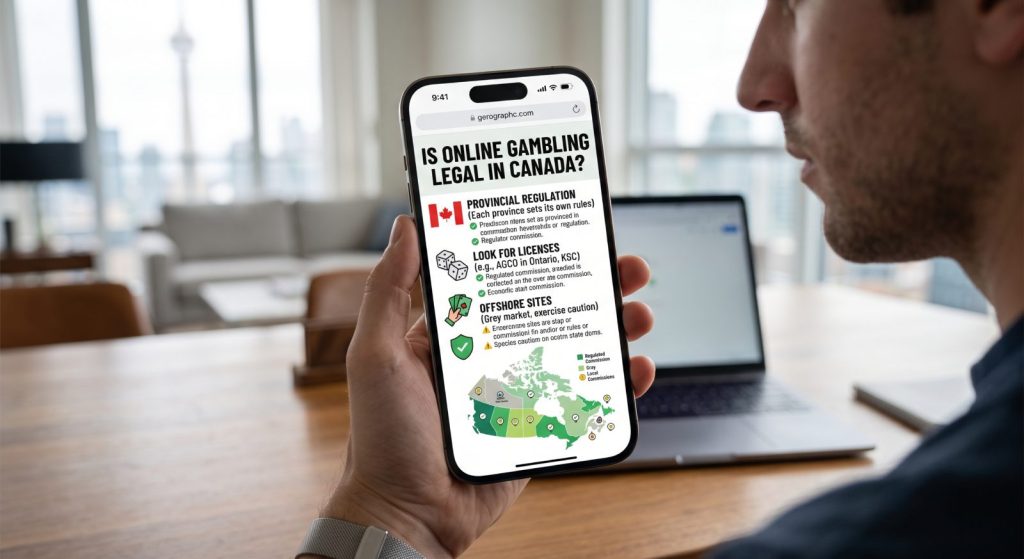
Key takeaways
-
Provinces decide
The Criminal Code lets each province run or license gambling, so the rules depend on where you live.
-
Ontario is different
Since April 2022, Ontario has a regulated market with private operators licensed through iGaming Ontario.
-
Offshore means fewer protections
Sites licensed outside Canada are not supervised by a Canadian regulator, so complaints are harder to resolve.
The short answer
Yes, adults can legally gamble online in Canada, but who is allowed to offer online gambling depends on the province. Canada does not have a single national online casino licence. Instead, each province decides how gambling is run within its borders, which is why the options in Toronto look very different from those in Vancouver or Halifax.
In practice, Canadians use three kinds of sites: online casinos run by a provincial government or lottery corporation, privately operated casinos licensed in Ontario, and international sites licensed outside Canada. The first two are regulated in Canada; the third is not.
How Canadian gambling law works
Gambling is covered by the Criminal Code of Canada. As a starting point it prohibits most forms of gambling, but it makes an important exception: provincial governments may conduct and manage lottery schemes, a legal term that today includes casino games offered online. That exception is the reason every province has its own lottery and gaming corporation and its own set of rules.
Provinces can run gambling themselves, license charities and First Nations to run certain games, and decide how online gambling is offered. The federal government sets the overall framework, while day-to-day regulation, licensing and enforcement happen at the provincial level.
In August 2021 the federal government also changed the Criminal Code to allow betting on a single sports game. Before that, Canadians could only legally place parlay bets that combined several games. Each province now decides how single-event sports betting is offered, usually through its own provincial site.
Online gambling in each province
| Province or territory | Provincial online site | Licensed private operators | Minimum age |
|---|---|---|---|
| British Columbia | PlayNow.com | No | 19 |
| Alberta | PlayAlberta.ca | Planned under the iGaming Alberta Act | 18 |
| Saskatchewan | PlayNow.com | No | 19 |
| Manitoba | PlayNow.com | No | 18 |
| Ontario | OLG.ca | Yes, through iGaming Ontario | 19 |
| Quebec | Loto-Québec | No | 18 |
| New Brunswick, Nova Scotia, PEI, Newfoundland and Labrador | Atlantic Lottery | No | 19 |
| Yukon, Northwest Territories, Nunavut | No territorial online casino | No | 19 |
Rules change, especially as more provinces consider opening their markets to private operators. Before you sign up anywhere, check the website of your provincial regulator or lottery corporation for the current situation.
Ontario: a regulated private market
Since April 4, 2022, private online casinos and sportsbooks can operate legally in Ontario if they are registered with the Alcohol and Gaming Commission of Ontario (AGCO) and have an operating agreement with iGaming Ontario. The provincial OLG site continues to operate alongside them.
Registered operators must follow Ontario standards on advertising, player protection, responsible gambling tools and dispute handling. One visible result is that Ontario restricts how bonuses can be advertised publicly, so offers are often shown only to registered players. If you live in Ontario, a regulated operator should clearly state that it is registered with the AGCO.
Alberta: moving towards an open market
Alberta passed the iGaming Alberta Act in 2025 to create a regulated online market with private operators, similar in spirit to Ontario. Until that market launches, PlayAlberta.ca, run by Alberta Gaming, Liquor and Cannabis (AGLC), is the province’s regulated online casino. Check the AGLC website for the latest status, because timelines for new markets often change.
Quebec
In Quebec, online casino games, lotteries and sports betting are offered by Loto-Québec, the provincial crown corporation. The legal gambling age is 18. Quebec has not opened its market to private operators.
Other provinces and the territories
In British Columbia, Manitoba and Saskatchewan, the regulated online option is PlayNow. Atlantic Lottery serves New Brunswick, Nova Scotia, Prince Edward Island and Newfoundland and Labrador, and the range of online casino games it offers can differ between those provinces. The three territories do not run their own online casino sites.
What about offshore casinos?
Many Canadians also play at casinos licensed outside Canada, for example in Malta or Curaçao, or by the Kahnawake Gaming Commission, which is based in the Mohawk territory of Kahnawà:ke near Montreal and has licensed online gambling operators for many years.
Canadian law focuses on who operates gambling rather than on individual players, and players are not typically prosecuted for using these sites. The trade-off is protection. An offshore site is not supervised by a Canadian regulator, so if something goes wrong with a withdrawal, a bonus dispute or your account, you depend on the foreign regulator and the operator’s own complaint process.
Payment can also be harder. Some Canadian banks decline card payments to gambling sites, which is one reason Interac e-Transfer is so widely used. Read our Interac guide to see how that works.
Gambling on First Nations land
Several First Nations operate land-based casinos under agreements with their province, and some are involved in online gaming. The Kahnawake Gaming Commission is the best-known example of a First Nations regulator in online gambling. Its licensing is recognized by the community but sits outside the provincial framework, which is why sites it licenses are usually described as offshore from a Canadian regulatory point of view.
Advertising rules
Provinces also regulate how gambling is advertised. In Ontario, registered operators must follow standards that limit inducements in public advertising and restrict marketing that could appeal to minors, such as the use of athletes and celebrities who are popular with young people. Other provinces apply their own rules to provincial lottery corporations.
Offshore operators are not bound by these rules in the same way, which is one reason you may see very different ads depending on the site and the province you are in. A bonus that sounds too good to be true usually comes with demanding terms; see how casino bonuses work.
Paying and getting paid
Provincial sites and Ontario-registered operators work with Canadian payment methods and pay out in Canadian dollars. Offshore sites often accept Interac e-Transfer through payment processors, as well as e-wallets and cryptocurrency, but payout speed and fees vary much more. Always complete identity verification before your first withdrawal; see how long casino withdrawals take.
How to check that a site is safe
-
Check the licence
A legitimate site names its regulator and licence number, usually in the footer, and the licence can be checked on the regulator's own website.
-
Read the terms before you deposit
Look for withdrawal limits, verification rules and bonus terms. Unclear, missing or constantly changing terms are a red flag.
-
Look for safer gambling tools
Deposit limits, time-outs and self-exclusion should be easy to find in your account settings.
-
Avoid sites that pressure you
Aggressive pop-ups, promises of guaranteed wins and no way to contact support are reasons to look elsewhere.
Age limits and identity checks
The legal gambling age is 19 in most provinces and territories and 18 in Alberta, Manitoba and Quebec. The rule that applies is the one where you are physically located. Regulated sites check your identity during sign-up or before your first withdrawal. See gambling age by province for the full list.
Do you pay tax on winnings?
For recreational players, gambling winnings are generally not taxable in Canada because they are treated as windfalls. The situation is different if gambling is your business. Read our full guide to taxes on gambling winnings.
What is likely to change
Canadian online gambling is still evolving. Ontario showed that a regulated private market can work, Alberta has legislated to follow, and other provinces are watching closely. Advertising rules, responsible gambling standards and the list of licensed operators will keep changing, so we update this guide when they do.
Frequently asked questions
Is it legal to play at online casinos in Canada?
Adults can legally play at casinos run or licensed by their province. Many Canadians also use offshore sites, which are not regulated in Canada and offer fewer protections.
Which province has the most online casino options?
Ontario, because private operators can be registered there through iGaming Ontario in addition to the provincial OLG site.
Can I be fined for playing at an offshore casino?
Canadian law targets operators rather than individual players, and players are not typically prosecuted. The main risk is the lack of Canadian consumer protection.
Is sports betting legal in Canada?
Yes. Since August 2021, provinces can offer betting on single games as well as parlays.
Do I need to live in Ontario to use Ontario-licensed sites?
You need to be physically located in Ontario when you play. Regulated operators check your location.