

Key takeaways
-
RTP is long-term
A 96% RTP describes millions of spins, not your next session.
-
Volatility is the ride
High volatility means rarer but bigger wins; low volatility means smaller, more frequent wins.
-
Check the game info
The same slot can run at different RTP settings at different casinos.
What RTP means
RTP, or return to player, is the share of all money bet on a game that the game pays back over a very large number of rounds. A slot with an RTP of 96% is designed to return $96 for every $100 wagered in the long run. The remaining 4% is the house edge, which is how the casino earns money from the game.
RTP is a theoretical average calculated over millions of spins. In a single session, anything can happen: you can win far more or lose far more than the RTP suggests. Think of it as the average price of playing, not a promise about your result.
How RTP is calculated and tested
Game providers design each game mathematically: every symbol, reel position and bonus feature has a probability and a payout. From these, the theoretical RTP is calculated and confirmed by simulating huge numbers of rounds. Independent testing labs then check that the game’s random number generator and payouts behave as described before it is approved in regulated markets.
The random number generator decides the outcome of every spin independently. The game does not track whether it has paid recently, and there is no “hot” or “cold” period built into it.
Why your session rarely matches the RTP
Imagine you play 200 spins at $1 each on a 96% RTP slot. On average you would expect to lose about $8 of the $200 you wager, but real sessions spread widely around that figure. One player might finish $150 ahead after a lucky bonus round, another might lose their whole $100 deposit without a single feature. Both results are perfectly consistent with a 96% RTP.
The more rounds you play, the closer your overall result tends to drift toward the theoretical return. That is why casinos can rely on the house edge across millions of bets, while an individual player can have very different results from one evening to the next. It also means that playing longer does not help you “catch up”: over time, the house edge works steadily in the casino’s favour.
Expected cost per hour
A practical way to use RTP is to estimate what an hour of play costs on average. Multiply your bet size by the number of rounds per hour and by the house edge. A slot at $1 per spin, about 500 spins an hour and a 4% house edge has an expected cost of roughly $20 per hour. The same budget on a 97% RTP slot costs about $15 per hour, and on a 92% version of the same game about $40.
| Bet per spin | Spins per hour | RTP | Average cost per hour |
|---|---|---|---|
| $0.50 | 500 | 96% | About $10 |
| $1 | 500 | 96% | About $20 |
| $1 | 500 | 92% | About $40 |
| $2 | 500 | 96% | About $40 |
These are averages, not limits: a single hour can cost much more or much less. They are still a useful reality check when you set a session budget.
Typical RTP and house edge by game
| Game | Typical RTP | House edge |
|---|---|---|
| Online slots | About 94–97% | About 3–6% |
| Progressive jackpot slots | Often lower than regular slots | Part of each bet funds the jackpot |
| Blackjack (basic strategy) | About 99–99.5% | About 0.5–1% |
| European roulette (single zero) | 97.3% | 2.7% |
| American roulette (double zero) | 94.7% | 5.3% |
| Baccarat (banker bet) | About 98.9% | About 1.1% |
Table game figures assume standard rules and correct play. Small rule changes, such as paying 6:5 instead of 3:2 for a blackjack, can increase the house edge noticeably.
What volatility means
Volatility, sometimes called variance, describes how wins are spread out. Two slots can have exactly the same RTP but feel completely different to play: one pays small amounts often, the other pays rarely but sometimes very large amounts.
Low volatility
Frequent small wins and slower swings in your balance. Suits longer sessions on a small budget.
Medium volatility
A balance of regular small wins and occasional bigger bonus features.
High volatility
Long dry spells with the chance of large wins. Your balance can drop quickly.
Hit frequency
Some games also show a hit frequency: how often a spin returns any win at all. A hit frequency of 25% means roughly one spin in four pays something, although many of those wins are smaller than the bet. Hit frequency and volatility together tell you more about how a game will feel than RTP alone.
Example: same budget, different volatility
| Low volatility slot | High volatility slot | |
|---|---|---|
| RTP | 96% | 96% |
| Budget | $50 at $0.50 per spin | $50 at $0.50 per spin |
| Typical session | Many small wins, balance moves slowly | Long runs without wins, occasional big feature |
| Chance of a big win | Low | Higher |
| Chance of losing the $50 quickly | Lower | Higher |
Neither is better. Low volatility suits players who want long, steady sessions; high volatility suits players who accept losing the budget for a chance at a larger win. Choose based on your budget and what you enjoy.
One slot, several RTP versions
Many popular slots are released with several RTP settings, for example 96%, 94% and 92%. The casino chooses which version to offer. The game looks identical, but the long-term cost of playing is different. The number shown in the game’s info screen is the one that applies at that casino, so it is worth checking before you play a favourite game at a new site.
Bonus buys and jackpots
RTP in live dealer and table games
Live dealer games use real cards, wheels and dealers streamed from a studio, so there is no random number generator deciding the result. Their RTP comes from the rules of the game itself, exactly as at a land-based table. Side bets are the main thing to watch: they often carry a much higher house edge than the main bet, even when the main game has an excellent return.
In games with decisions, such as blackjack or video poker, the published RTP assumes you play the mathematically correct move every time. Guessing or following hunches lowers your real return, sometimes by several percentage points.
Some slots let you buy direct entry to the bonus round. The RTP of that feature can differ slightly from the base game and the cost per round is much higher, so your budget runs out faster. Progressive jackpot slots put part of every bet into the jackpot, which usually means a lower everyday return in exchange for the small chance of a very large prize.
How to find a game’s RTP
-
1
Open the game info
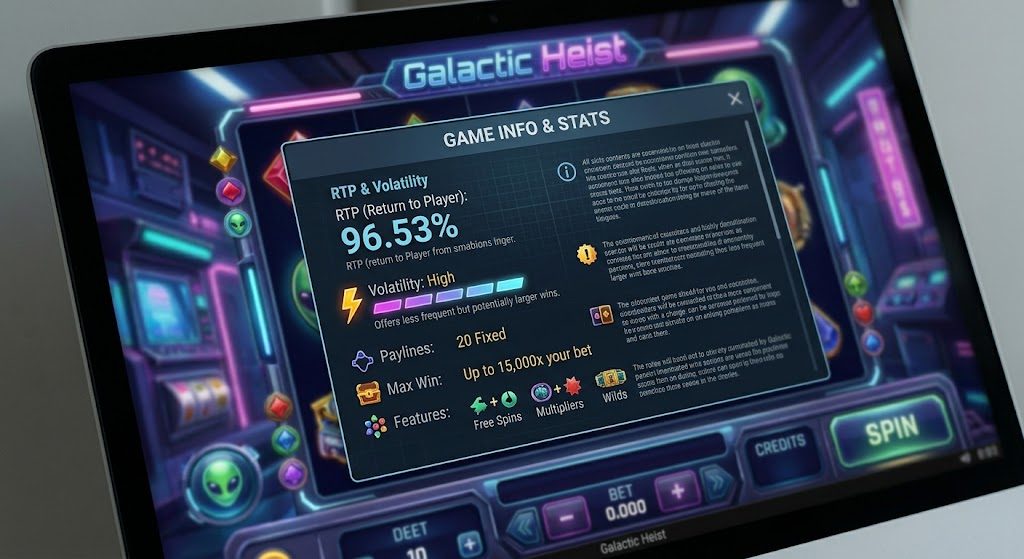
Look for the "i", paytable or help menu inside the game.
-
2
Find the RTP line
Most providers list the theoretical return in the rules section, sometimes next to the volatility rating.
-
3
Compare casinos
Some slots have several RTP versions. The number shown in the game is the one that applies at that casino.
How to use RTP and volatility
- Prefer games with an RTP around 96% or higher when the choice is between similar slots.
- Match volatility to your budget: lower volatility for small budgets and long sessions.
- Use smaller bets on high-volatility games so your budget lasts through dry spells.
- Set a session budget and stop when it is gone, whatever the RTP.
Common myths
-
"A slot is due to pay"
Each spin is independent. Past results do not change the odds of the next spin.
-
"High RTP means I will win"
RTP lowers the average cost of playing; it does not guarantee a profit.
-
"Strategy beats slots"
Slots are pure chance. Only budget, bet size and game choice are in your control.
-
"Casinos change RTP during the day"
Regulated games run at a fixed, certified setting; the casino picks the version, not the time.
RTP also matters for bonuses: some casinos exclude high-RTP slots from wagering, and the house edge decides how much a wagering requirement really costs. See wagering requirements explained.
Frequently asked questions
What is a good RTP for a slot?
Around 96% or higher is generally considered good for online slots.
Does RTP change during the day?
No. Licensed games run at a fixed RTP setting; the casino chooses the version, not the time of day.
Which casino game has the lowest house edge?
Blackjack played with basic strategy usually has one of the lowest house edges, followed by baccarat banker bets.
Is a high volatility slot riskier?
It is more likely to empty a budget quickly, but it also offers bigger occasional wins. The long-term cost depends on RTP.
Where do I find a slot's volatility?
Many providers show it in the game info as a rating or a scale of lightning bolts. If it is not listed, reviews and demo play give a good impression of how often the game pays.
Does a bigger bet change the RTP?
In most slots, no: the RTP is the same at every bet size. A bigger bet only makes the average cost and the swings larger in dollar terms.
Play for entertainment
RTP and volatility help you choose games and size your bets, but they cannot turn gambling into a way to make money. Decide in advance what a session is worth to you, use the limit tools at your casino and take breaks. Our guide to setting deposit limits explains how.